




Resin materials are employed in the production of jewellery, craft, art, coatings, electronics, furniture and industrial manufacture. There are various kinds of resin to choose from, two of the most popular are epoxy resin and UV resin.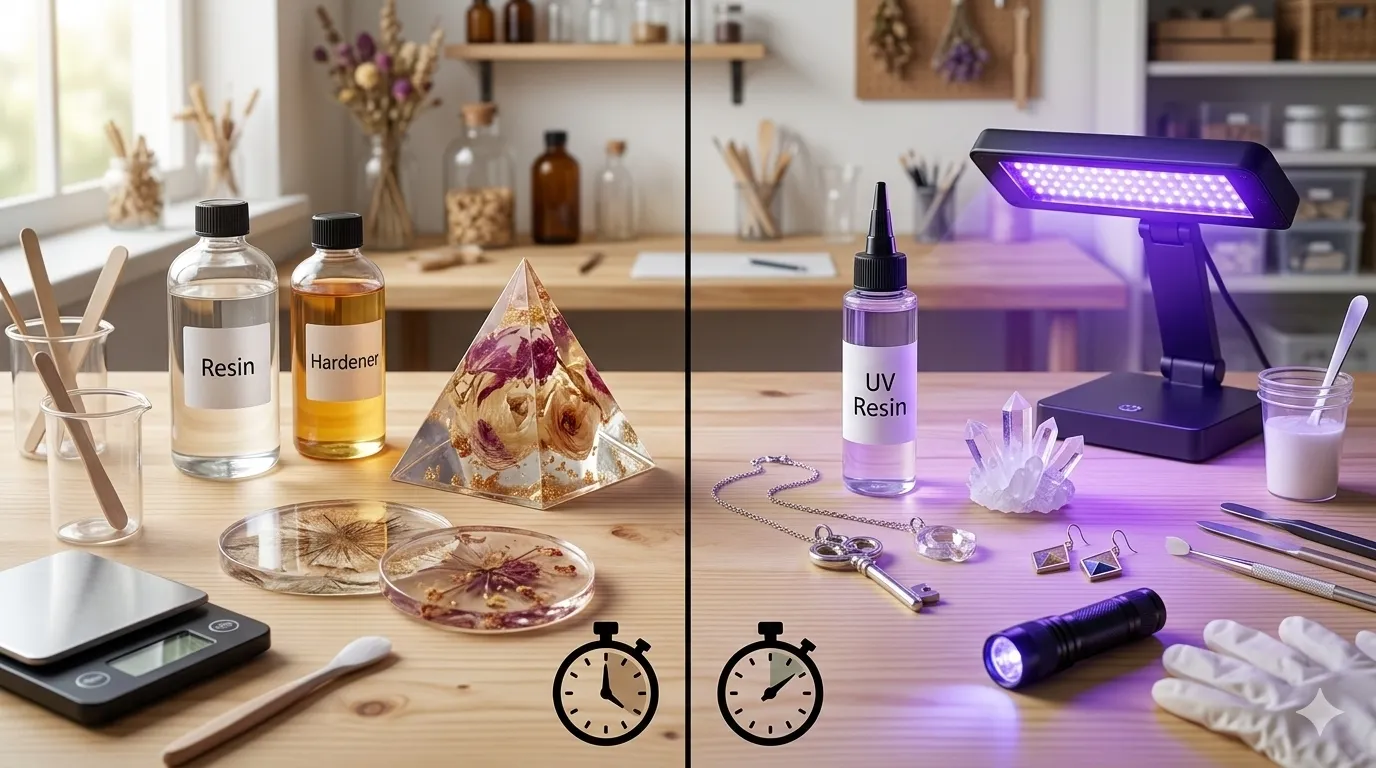
Both materials can give a shiny, tough and pretty surface, but function in very different ways. The way they are cured, how long they take to cure, their applications, price and performance may influence the selection of material for your project.
Then what is the difference between epoxy resin and UV resin, which to use and when?
This guide contrasts epoxy resin with UV resin in order to guide artists, DIY users, manufacturers and industrial buyers to choose the appropriate resin for the task.
What Is Epoxy Resin?
Epoxy resin is a two-component material typically made from:
- Epoxy resin
- Hardener
Prior to use, both components should be mixed in the recommended mixing ratio. The resin starts to cure into a hard and durable material after mixing.
The curing time of epoxy resin may vary from several hours to even days, depending on the formula.
Epoxy resin is found to be used for a number of applications, such as:
- River tables
- Resin art
- Jewelry
- Wood coatings
- Flooring
- Countertops
- Composite materials
- Electronics
- Industrial adhesives
- Protective coatings
Epoxy resin has many benefits, such as its versatility. Various casting, coating, bonding, potting, and industrial formula can be developed for manufacturers.
What Is UV Resin?
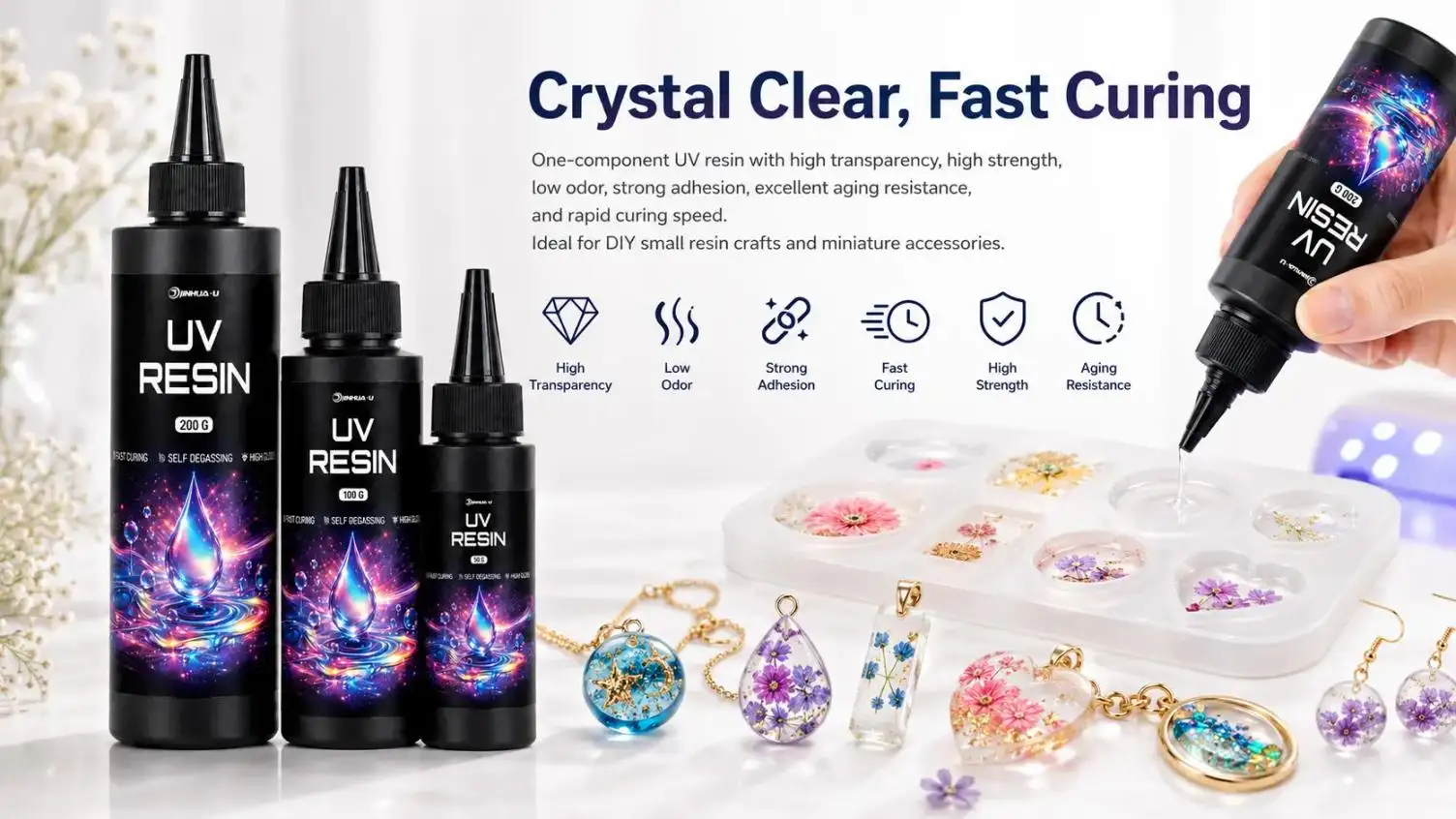
A resin which is already mixed and can only be cured by UV light.
Unlike the conventional two-part epoxy resin, UV resin typically doesn't require a separate hardener. The material stays liquid until it comes in contact with an appropriate UV light source.
The curing process will start quickly when the photoinitiators within the resin are activated by UV light.
The most typical application of UV resin is:
- Small jewelry pieces
- Resin charms
- Crafts
- Decorative items
- Small molds
- Quick repairs
- Nail art applications
- Small-scale prototyping
The main advantage of UV resin is speed. In many applications, UV resin can cure within minutes when exposed to a sufficiently powerful UV lamp.
However, UV light must be able to reach the resin effectively, which creates limitations for deep or opaque projects.
Epoxy Resin vs UV Resin: Key Differences
1. Curing Method
The biggest difference between epoxy resin and UV resin is how they cure.
Epoxy Resin
Epoxy resin cures through a chemical reaction between the resin and hardener.
After the two components are mixed correctly, curing begins automatically.
The material does not need UV light to cure.
UV Resin
UV resin cures when exposed to ultraviolet light.
Without sufficient UV exposure, the resin may remain sticky, soft, or partially cured.
Which Is Better?
If you need a resin that can cure without special lighting equipment, epoxy resin is generally the better choice.
If fast curing is important and you have access to a UV lamp, UV resin can be more convenient.
2. Curing Speed
Curing speed is another major difference.
Epoxy Resin
Epoxy resin usually has a longer curing process.
Depending on the product, initial curing may take:
- Several hours
- 12–24 hours
- Multiple days for complete curing
This longer working time is useful for larger projects because users can mix colors, remove bubbles, arrange decorations, and adjust the design.
UV Resin
UV resin can cure much faster.
Small projects may cure in just a few minutes under an appropriate UV lamp.
This makes UV resin ideal for fast production and small craft projects.
Which Is Better?
Choose UV resin when speed is the top priority.
Choose epoxy resin when you need more working time and better control over large projects.
3. Working Time
Epoxy resin provides a longer working time, often called pot life or open time.
This allows users to:
- Add pigments
- Create artistic effects
- Pour multiple layers
- Position objects
- Remove air bubbles
- Work with large molds
UV resin has a different workflow. Because it begins curing when exposed to UV light, users can keep the resin liquid until they intentionally expose it to the curing lamp.
However, once UV curing begins, the material can harden quickly.
For detailed projects requiring a longer processing time, epoxy resin is often easier to manage.
4. Suitable Project Thickness
This is one of the most important factors when choosing between epoxy resin and UV resin.
Epoxy Resin for Deep Casting
Epoxy resin can be formulated for different pouring depths.
For example, manufacturers offer:
- Coating epoxy resin
- Casting epoxy resin
- Deep pour epoxy resin
Deep pour epoxy systems are designed to cure thicker layers while controlling heat generation.
This makes epoxy resin suitable for:
- River tables
- Large molds
- Thick artwork
- Decorative castings
- Industrial components
UV Resin for Thin Layers
UV resin works best when UV light can penetrate the material.
For this reason, it is generally more suitable for:
- Thin coatings
- Small molds
- Jewelry
- Charms
- Small decorative pieces
Very thick or opaque UV resin layers may not cure evenly because the UV light cannot reach the deeper areas effectively.
Winner for Thick Projects: Epoxy Resin
5. Mixing Requirements
Epoxy resin usually requires precise mixing.
The manufacturer may recommend a mixing ratio such as:
- 1:1
- 2:1
- Other specialized ratios
Incorrect mixing can cause problems such as:
- Sticky surfaces
- Soft curing
- Uneven hardness
- Reduced durability
UV resin is generally easier to use because it is supplied as a ready-to-use material.
There is usually no need to measure and mix a separate hardener.
Winner for Convenience: UV Resin
6. Equipment Requirements
Epoxy resin typically requires basic tools such as:
- Mixing cups
- Stirring sticks
- Measuring tools
- Gloves
- Molds
UV resin usually requires a UV curing source for reliable results.
Common equipment includes:
- UV lamp
- UV flashlight
- UV curing machine
Therefore, epoxy resin may be easier for users who do not want to purchase additional curing equipment.
7. Durability and Performance
Both epoxy resin and UV resin can provide excellent performance when the correct product is selected for the application.
Epoxy resin is known for its strong adhesion, mechanical performance, and versatility. Specialized epoxy systems can provide:
- High hardness
- Strong bonding
- Chemical resistance
- Water resistance
- Electrical insulation
- Heat resistance
UV resin can also create a hard and glossy surface, especially for small decorative products.
However, epoxy resin generally offers more formulation options for demanding industrial and large-scale applications.
Winner for Industrial Versatility: Epoxy Resin
8. Cost Comparison
The cost of epoxy resin vs UV resin depends on the product, brand, formula, and application.
For large-volume projects, epoxy resin is often more economical because it is commonly available in larger quantities.
UV resin can be more expensive per unit volume, especially for large casting projects.
For small jewelry or craft applications, however, the convenience and fast curing speed of UV resin may justify the higher material cost.
Best for Large Projects: Epoxy Resin
Best for Small, Fast Projects: UV Resin
Epoxy Resin vs UV Resin: Application Comparison
| Application | Recommended Resin |
|---|---|
| River tables | Epoxy resin |
| Large molds | Epoxy resin |
| Deep casting | Epoxy resin |
| Resin flooring | Epoxy resin |
| Electronics potting | Epoxy resin |
| Small jewelry | UV resin |
| Resin charms | UV resin |
| Quick crafts | UV resin |
| Fast repairs | UV resin |
| Thin decorative coatings | UV resin |
| Large artwork | Epoxy resin |
How to Choose Between Epoxy Resin and UV Resin
The best choice depends on your project requirements.
Choose epoxy resin if you need:
- Large-volume casting
- Deep pours
- Longer working time
- Strong industrial performance
- Furniture applications
- Flooring
- Composite materials
- Custom resin formulations
Choose UV resin if you need:
- Fast curing
- Small projects
- Easy application
- Ready-to-use resin
- Jewelry production
- Decorative crafts
- Thin resin layers
- Quick manufacturing cycles
Consider Your Production Environment
For manufacturers and professional users, resin selection should also consider:
- Production speed
- Product thickness
- Equipment availability
- Material cost
- Required mechanical properties
- UV exposure requirements
- Surface appearance
- Long-term durability
A professional resin manufacturer can help develop customized formulas for specific production requirements.
Can You Use Epoxy Resin and UV Resin Together?
In some creative applications, users may combine epoxy resin and UV resin in different stages of a project.
For example, epoxy resin may be used to create the main structure of a large piece, while UV resin can be used for small decorative details or fast surface repairs.
However, compatibility should always be tested before combining different resin systems.
Different formulas may have different adhesion properties, curing behavior, and surface chemistry.
For professional manufacturing, material compatibility testing is recommended.
Final Thoughts: Epoxy Resin or UV Resin?
There is no universal material that is superior in comparison between epoxy resin vs UV resin.
Epoxy resin is typically used in large-scale projects, deep casting, industrial applications, furniture, and for situations that demand high mechanical properties.
For small projects where fast curing, convenience and simplicity of workflow are required, UV resin is ideal.
The specific resin to use will depend on the application, production needs, conditions and performance you wish to achieve.
The selection of a resin supplier is also crucial for businesses, manufacturers, and product developers. A good resin manufacturer should be able to offer technical support, quality product, and customized formulas for use in various applications, from art and crafts to electronics and industrial production.
When choosing a resin, you need to take into account the size of your project, the speed of cure, the thickness of the layers, equipment and how the resin is expected to perform. Epoxy resin and UV resin are two distinct types, and by understanding the differences between them you will be able to select the material that will provide the best quality, efficiency and cost in your application.