





Electronic components are getting smaller, faster and more sensitive to the challenging operating environments. Electronic devices, such as automotive control units, LED modules, sensors, power supplies, and industrial circuit boards, often require moisture, dust, vibration, chemical and mechanical stress protection.
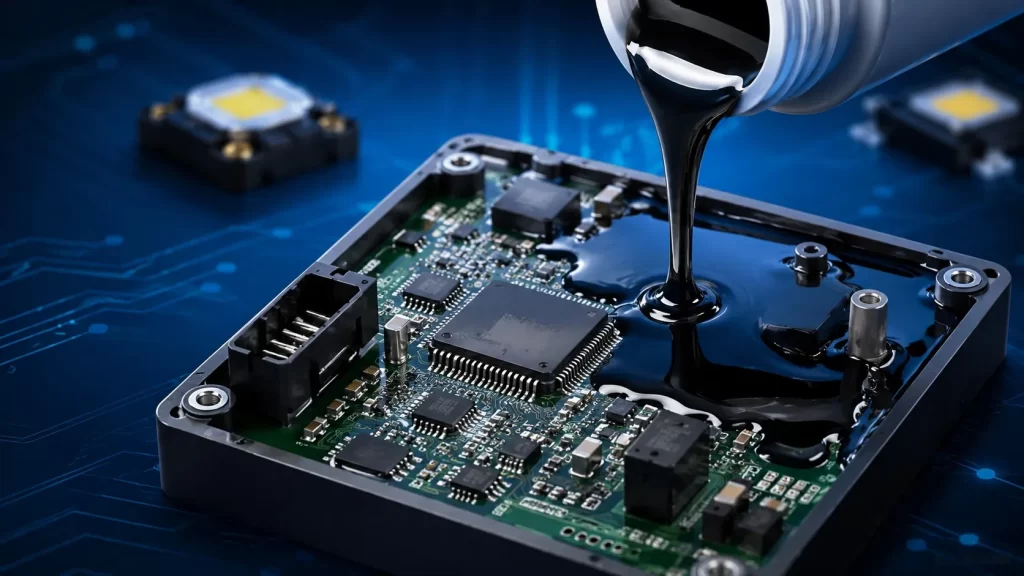
This is where epoxy resin for electronic potting comes into its own. Epoxy resin provides excellent electrical insulation and mechanical stability, and completely encloses electronic components to form a good insulated shell.
So, why is epoxy resin the best choice for electronic potting? It's about the protection, durability, adhesion, electrical properties and customizability.
What Is Electronic Potting?
Electronic potting is a process in which electronic components or assemblies are enclosed in a protective compound. Material flows around the object and hardens into a protective solid or rubber-like material.
The main use of electronic potting is to isolate the sensitive electronics from external environment and mechanical influences.
Common applications include:
- Printed circuit boards (PCBs)
- Sensors and control modules
- LED lighting systems
- Automotive electronics
- Power supplies and transformers
- Battery management systems
- Industrial control equipment
- Electronic connectors
- Communication devices
When high mechanical strength, excellent adhesion and strong environmental resistance are required, epoxy resin is widely used among the various potting materials available.
1. Excellent Electrical Insulation
Epoxy resin has one of the best electrical insulation properties of all the potting materials used in electronics.
Electronic components must be protected from unwanted electrical contact, moisture causing leakage and short circuiting. When cured correctly, epoxy resin is an insulating material that envelops the components.
This means that epoxy potting is an ideal choice for applications where electrical reliability is paramount.
For instance, epoxy resin can be used to seal circuit boards, sensors, coils and other electronic components or assemblies. The cured material will act as an effective barrier to contaminants that might conduct electricity from the outside, but will allow the parts to conduct as intended.
In high-voltage or sensitive applications, the manufacturer needs to choose a potting epoxy that meets the relevant requirements of the dielectric strength, insulation resistance and operating temperature.
2. Strong Protection Against Moisture and Dust
Water is among the greatest hazards of electronic components. Corrosion, electrical leakage, and component failure can result from water, humidity, condensation and airborne contaminants.
Epoxy potting produces a continuous protective layer around the electronic assemblies. If the formulation and application process are correctly chosen, exposure to moisture, dust and other contaminants can be considerably minimised.
This is particularly beneficial for electronic devices in:
- Outdoor equipment
- Automotive systems
- Industrial machinery
- Marine environments
- LED lighting
- Sensors
- Electrical control systems
The effectiveness of protection will depend upon the application conditions, enclosure design, curing process, and type of epoxy formulation.
3. High Mechanical Strength
During transport and operation, electronic components are subject to vibrations, impacts, shocks and mechanical stresses.
Epoxy resin is a material with a relatively hard, strong cured product. For potting, it aids in maintaining the integrity of the components and helps to minimize the vibration or other external forces that cause motion.
This is especially useful in automotive and industrial applications where the equipment might be subjected to stressful conditions in continuous use.
Epoxy potting can also help to keep parts in place, thus preventing loose connections, movement, and mechanical stress damage.
4. Excellent Adhesion to Different Materials
Epoxy resin's ability to adhere strongly is another great benefit.
Electronic assemblies frequently have a combination of materials, such as metals, plastics, ceramics, fiberglass, and electronic components. To ensure good encapsulation, a potting compound must adhere to the surrounding surfaces effectively.
Epoxy resin can provide good bonding strength to a variety of popular electronic materials, but it is dependent upon the formulation and surface treatment.
Minimizing gaps and weak interfaces at joints through good adhesion prevents moisture or contaminants from entering the structure. It also helps to provide the overall mechanical stability of the encapsulated assembly.
5. Good Chemical Resistance
Oils, cleaning agents, fuels, solvents or other chemicals can be used for the application of electronic devices.
Numerous epoxy potting media resist a wide variety of chemicals. This makes them ideal for use in industrial, automotive, electrical and other harsh applications.
But, the resistance to chemicals is different in various epoxy formulations. The manufacturers should consider the individual chemicals, concentration, temperature and time of exposure when choosing a potting material for special applications.
6. Thermal Protection and Heat Management
Electronic components heat up when they are activated. Strenuous heat will reduce component life and have a detrimental impact on system reliability.
Epoxy resin can offer some beneficial thermal protection and mechanical strength. Certain thermally conductive epoxy potting compounds can do more than that - they can transfer heat from the heat-producing components to an appropriate heat dissipation path.
This is particularly pertinent to:
- Power electronics
- LED modules
- Battery systems
- Motor controllers
- Transformers
- Automotive electronic modules
It's important to know the difference between regular insulating epoxy and thermally conductive epoxy. If thermal management is a critical consideration, thermal conductivity, operating temperature, cure behavior and electrical insulation are the factors to consider in selecting the material.
7. Excellent Dimensional Stability
Epoxy resin has good dimensional stability and will tend to remain its shape after curing.
This is convenient for electronic potting applications as the material should not shrink or deform too much around the components.
Low shrinkage formulations help minimize mechanical stresses on sensitive components during cure. This is especially critical in precision electronic assemblies where excessive internal stress may have a detrimental effect on the reliability of the components.
8. Customizable Formulations
Not all e-applications need the same potting material. Various devices can require various combinations of hardness, flexibility, curing speed, thermal conductivity, flame resistance, etc. for the hardness, flexibility and curing speed, thermal conductivity, flame resistance, viscosity etc. of the environment resistance.
The epoxy can be formulated to suit particular application needs.
The manufacturer can choose formulations that have properties like:
- Low viscosity for easier filling
- Fast or controlled curing
- High temperature resistance
- Flame-retardant performance
- Thermal conductivity
- High dielectric strength
- Low shrinkage
- Improved chemical resistance
- Different hardness levels
This flexibility makes epoxy resin a versatile choice for electronic potting across different industries.
9. Reliable Long-Term Protection
The primary goal of electronic potting is not just to enclose a component. It's done for reliability over the product's service life.
A well-designed and treated epoxy potting compound can guard against more than one of these environmental challenges: moisture, dust, vibration, chemicals, mechanical damage.
This can contribute to longer product life and reduced maintenance requirements.
But the durability of the resin is not the only factor. All preparation of components, mixing ratios, degassing, curing conditions, thermal design and material compatibility are all important.
How to Choose Epoxy Resin for Electronic Potting
When selecting an epoxy potting compound, manufacturers should evaluate the complete operating environment rather than focusing on one property.
Important considerations include:
Viscosity: Low-viscosity epoxy can flow more easily around small components and complex structures.
Curing time: Choose a curing speed that matches the production process and required throughput.
Operating temperature: The cured epoxy should withstand the expected temperature range.
Thermal conductivity: Thermally conductive grades may be necessary for heat-generating electronics.
Electrical properties: Check dielectric strength and insulation resistance for electrical applications.
Hardness: Hard epoxy provides strong mechanical protection, while specialized flexible systems may be better for stress-sensitive components.
Environmental resistance: Consider moisture, chemicals, vibration, UV exposure, and other application-specific conditions.
Flame resistance: For certain electronic products, flame-retardant performance may be an important requirement.
Conclusion
Thus, what are the best qualities of epoxy resin for electronic potting? The major strength of its use is that it possesses several protective properties all in one material.
Epoxy resin has good electrical insulation, adhesion, mechanical protection, waterproof, chemical resistance, dimensional stability and long-term environment protection. Specific formulations can also include thermal conductivity, flame resistance or tailored curing properties.
Therefore, selecting the right epoxy potting compound is an important step for electronics manufacturers in terms of product reliability and quality control.
This depends on the electronic component, operating environment, production process and the desired performance. This allows the manufacturer to design more robust and protected electronic assemblies to meet those demands by selecting the appropriate epoxy formulation.