





Because of its resistance to impact, shock, and high temperatures, as well as its ability to self-repair and resist abrasion, epoxy resin is now one of the more common materials in many industries such as crafts, furniture manufacturing, electronics, construction, and industrial coatings. One common problem with applying epoxy is the occurrence of air bubbles. These bubbles can cause defects in the finished product, lower strength and impact appearance.
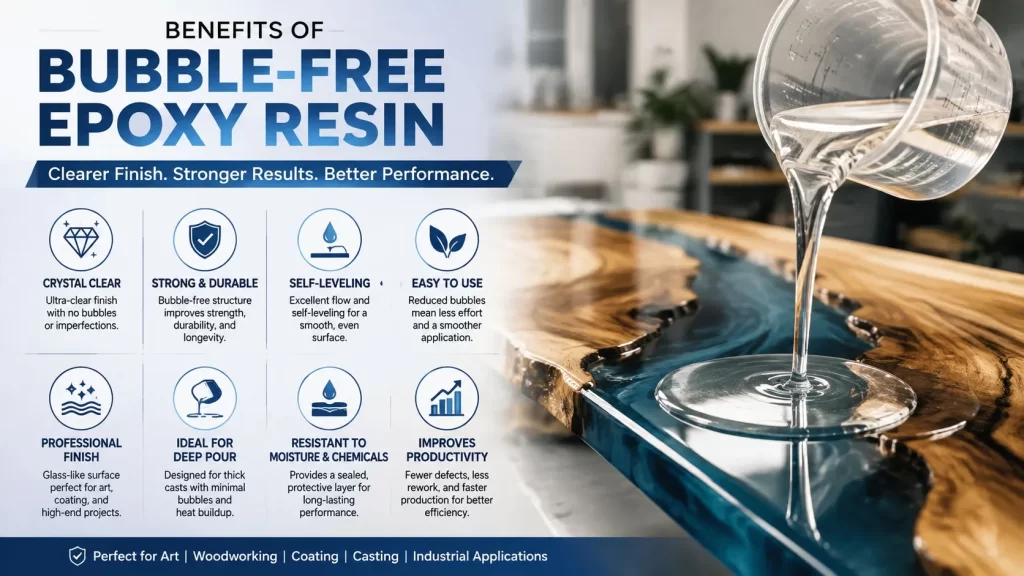
Epoxy resin is made to be free of bubbles when preparing, pouring and curing. Bubble-free epoxy resin will result in smoother finishes, greater durability, better performance and results with improved formulation and advanced self-leveling properties.
This article delves into the key advantages of bubble-free epoxy resin, its uses, and its growing popularity among professionals and manufacturers.
What Is Bubble-Free Epoxy Resin?
Bubble Free Epoxy Resin: Epoxy resin specially formulated to minimize bubbles in the process of curing. Doing so can leave air trapped in the epoxy resin during the mixing of resin and hardener, particularly if it is stirred too rapidly or if thicker layers of the resin are poured.
A good quality, bubble-free epoxy resin usually will include:
- Low viscosity for easier air release
- Self-leveling properties
- Slow and controlled curing reaction
- Improved flow performance
- Enhanced transparency and surface quality
This property enables the bubbles to rise to the surface of the resin before the resin is completely hardened, resulting in a clear, smooth and professional finish.
1. Provides a Crystal-Clear and Professional Appearance
The main benefit of bubble-free epoxy resin is that it is very aesthetically pleasing.
In cases where appearance is important like:
- River tables
- Jewelry making
- Decorative crafts
- Artwork coating
- Transparent castings
even small bubbles can negatively impact the final product. Epoxy resin without a bubble forms a clear, glass-like surface with no cloudiness or blemishes.
A high transparency makes embedded materials like wood, flowers, pigments and decorative elements clearly visible, perfect for artistic or premium uses.
2. Reduces Surface Defects and Rework
Defects can cost more in production and result in loss of material in manufacturing and professional projects.
Inside cured epoxy air bubbles will result in:
- Uneven surfaces
- Tiny holes
- Weak spots
- Poor visual appearance
- Additional repair work
These problems can be reduced to a minimum with a bubble-free epoxy resin because trapped air can be removed prior to cure. This helps to boost efficiency of production and less sanding, polishing or reapplication is required.
When manufacturing, fewer defects is equal to:
- Lower material waste
- Faster production cycles
- More consistent product quality
3. Creates a Stronger and More Durable Material
Bubbles are a cosmetic problem but can also have an impact on mechanical performance.
Cured epoxy has weak points due to air pockets inside which can lead to the formation of cracks. Epoxy that comes without bubbles results in a more consistent structure and better:
- Impact resistance
- Tensile strength
- Adhesion performance
- Long-term durability
This eliminates the possibility of air bubbles that could compromise the quality or performance of the product, making bubble-free epoxy resin ideal for applications that demand robustness and reliability, such as protective coatings, composite materials, industrial components, and more.
The tightness of the foam structure and absence of bubbles will ensure the epoxy's reliability in the face of environmental exposure and stress.
4. Easier Application for Beginners and Professionals
Traditional epoxy resin often requires advanced techniques to remove bubbles, including:
- Using heat guns
- Applying a torch carefully
- Vacuum degassing
- Special mixing methods
These processes will need experience in the execution and can introduce other risks when not performed correctly.
The presence of bubbles in epoxy resin can make it more difficult to apply. The formula is highly developed, so that users can obtain smooth results by using less tools and less technical knowledge.
Benefits include:
- Easier mixing
- Better flow
- Less manual correction
- More predictable curing results
This makes it a popular choice for both DIY users and professional manufacturers.
5. Excellent Self-Leveling Performance
The quality of the epoxy resin is usually very good if there is no bubbles.
The resin pours itself and fills in small gaps and gives an even coat.
Self-leveling performance is especially important for:
- Epoxy flooring
- Tabletops
- Countertops
- Coating applications
- Decorative surfaces
A smooth finish makes the product look better and protects it from moisture and chemicals as well as wear and tear.
6. Ideal for Deep Pour and Casting Applications
Deep casting projects are especially challenging because thicker epoxy layers naturally trap more air.
Bubble-free epoxy resin is widely used for:
- Large resin art projects
- Wood and resin furniture
- Decorative blocks
- Industrial casting parts
Its controlled curing process helps reduce internal bubbles and overheating problems during thicker pours.
For deep-pour applications, choosing a low-bubble or bubble-free epoxy formula can significantly improve clarity and final quality.
7. Improves Productivity in Industrial Manufacturing
In industrial environments, efficiency and consistency are critical.
Bubble-free epoxy resin helps manufacturers achieve:
- Faster production times
- Reduced inspection failures
- Stable product quality
- Lower labor costs
Industries that benefit from bubble-free epoxy resin include:
Electronics Industry
Used for:
- Electronic potting
- Component protection
- Insulation applications
A bubble-free structure improves electrical insulation and protects sensitive components from moisture and vibration.
Composite Manufacturing
Used with:
- Carbon fiber
- Fiberglass
- Reinforcement materials
Bubble reduction improves the strength and reliability of composite parts.
Coating Industry
Used for:
- Industrial floors
- Protective coatings
- Decorative surfaces
Smooth, defect-free coatings provide better appearance and longer service life.
8. Better Resistance to Moisture and Chemicals
A bubble-free epoxy surface creates a more continuous protective barrier.
Without internal air gaps, cured epoxy offers improved resistance against:
- Water penetration
- Chemicals
- Dust
- Environmental damage
This makes it suitable for applications requiring long-term protection, including industrial equipment, laboratories, and manufacturing facilities.
9. Enhances Customer Satisfaction and Product Value
For businesses producing epoxy-based products, appearance directly affects customer perception.
A bubble-free finish gives products:
- Premium appearance
- Higher perceived value
- Better durability
- Professional quality
Whether producing furniture, crafts, coatings, or industrial components, high-quality epoxy resin can help businesses build stronger brands and improve customer satisfaction.
How to Choose the Right Bubble-Free Epoxy Resin
When selecting bubble-free epoxy resin, consider the following factors:
1. Application Purpose
Different projects require different epoxy formulas:
- Art and crafts: High transparency and UV resistance
- Deep casting: Low heat generation and long working time
- Coatings: Fast curing and strong adhesion
- Industrial use: High mechanical strength
2. Viscosity
Lower viscosity epoxy resin generally allows air bubbles to escape more easily.
3. Curing Time
A longer curing time provides more opportunity for bubbles to rise and disappear naturally.
4. UV Resistance
For transparent and decorative applications, UV-resistant formulas help prevent yellowing over time.
5. Manufacturer Quality
Reliable epoxy resin manufacturers provide:
- Stable formulations
- Consistent performance
- Technical support
- Custom solutions for different industries
Bubble-Free Epoxy Resin vs Traditional Epoxy Resin
| Feature | Bubble-Free Epoxy Resin | Traditional Epoxy Resin |
|---|---|---|
| Bubble Control | Excellent | Requires additional techniques |
| Surface Finish | Smooth and clear | May contain defects |
| Application Difficulty | Easier | More skill required |
| Appearance | Professional quality | Variable results |
| Production Efficiency | Higher | Lower due to rework |
| Suitable Applications | Premium and industrial uses | General applications |
Conclusion
The benefits of bubble-free epoxy resin are immense in terms of its look, strength, efficiency and simplicity. It minimizes trapped air, increases surface quality and enables users to achieve professional results in a multitude of applications.
Whether you're creating art, crafting furniture, or designing protective coatings for industries, bubble-free epoxy resin offers a dependable solution to ensure your products are stronger, clearer, and more durable.
With the increasing demand for high-quality epoxy solutions, manufacturers, professionals, and DIY enthusiasts are increasingly relying on epoxy resin that is free from bubbles.Epoxy bubble-free resin has become indispensable to various manufacturers, professionals, and do-it-yourself enthusiasts seeking the best performance and flawless finishes.