





For manufacturers looking to achieve repeatable quality, application-specific performance and flexible production methods, custom OEM epoxy resin is proving to be an important solution. The formulation of the custom epoxy resin is the difference between it and traditional off the shelf epoxy products; it can be created to meet the specific needs of a product, production process, or end-use application.
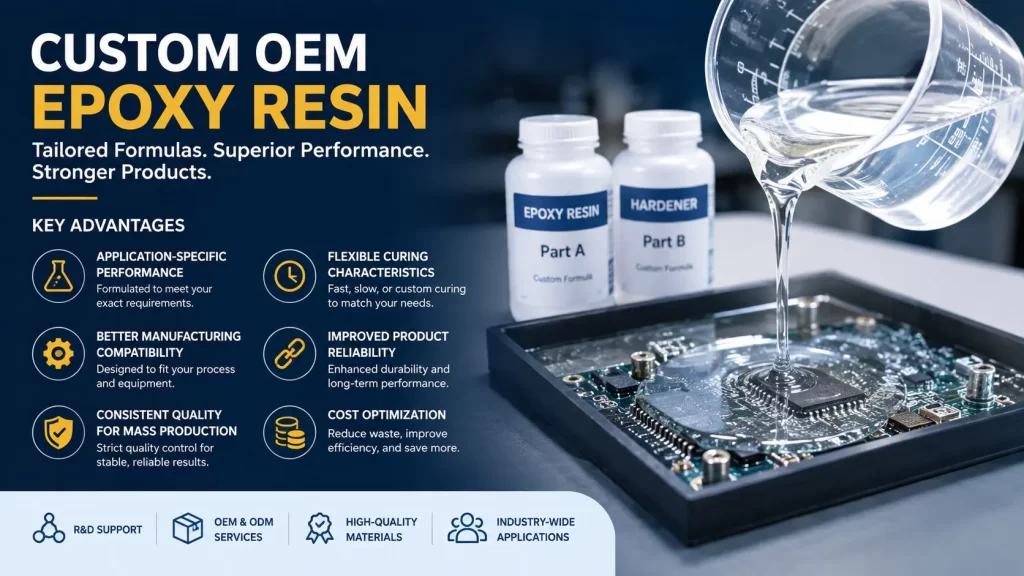
Epoxy Resin can be a key to superior product differentiation, performance, and efficiency in industries like electronics, automotive, construction, flooring, electrical equipment, and industrial manufacturing.
But what makes custom OEM epoxy resin a better choice for manufacturers? Let's take a look at some of the main advantages.
What Is Custom OEM Epoxy Resin?
Custom OEM epoxy resin means epoxy resin systems are formulated and/or modified and/or packaged or branded (as a whole) for a customer's specific needs.
The OEM epoxy resin manufacturer can tailor the following aspects:
- Resin and hardener formulation
- Mixing ratio
- Curing speed
- Viscosity
- Hardness and flexibility
- Thermal resistance
- Chemical resistance
- Electrical insulation
- Transparency and color
- Adhesion performance
- Packaging and labeling
This can offer the flexibility that the manufacturer can get an epoxy that is optimized for their production rather than have to modify their process to fit a generic epoxy.
1. Application-Specific Performance
The major benefit of custom OEM epoxy resin is that the performance can be optimised for a specific application.
The needs of various industries vary. For instance, electronic potting is often expected to be excellent electrical insulating and thermally stable; industrial flooring may need to be tough, resist chemicals and abrasion.
These requirements can be satisfied by a custom epoxy formulation.
Manufacturers can create epoxy resin that has various properties based on the application, such as:
- High mechanical strength
- Excellent adhesion
- Low shrinkage
- High temperature resistance
- Chemical resistance
- Moisture resistance
- Electrical insulation
- UV resistance
- Flexible or rigid curing
- Fast or slow curing
This application-specific approach may help to enhance product reliability and minimize performance compromises.
2. Better Manufacturing Compatibility
The standard epoxy resin is not always compatible with an ongoing production process. May present manufacturing problems due to viscosity, curing time, working time or mixing ratio.
OEM epoxy resin is custom formulated that enables the formulation to be tailored based on the customer's process.
For instance, automated dispensing equipment might have a particular viscosity variety, or it may not work at all if the viscosity is under or above the set range. For a large-scale casting process, a longer pot life can be needed to give enough time for the process. If high volume assembly is required, a faster curing system can be helpful.
The preparation of the formulation can be customized to fit into the existing production line more easily for OEM epoxy resin.
This can help the manufacturers to minimize the disruption in the process, production consistency and optimizing manufacturing efficiency.
3. Consistent Quality for Mass Production
One thing is crucial for B2B manufacturers, and that is consistency.
With applications on the scale of thousands or millions of products, even minor differences in viscosity, cure, adhesion, etc., can impact the product.
A reputable custom epoxy resin supplier can assist in setting up specifications for each batch. The supplier is able to continue to maintain the formulation and quality control in accordance with customer's needs.
Repetitive performance of epoxy resins can help to:
- Stable production processes
- More predictable curing
- Consistent product quality
- Lower rejection rates
- Easier quality control
- Better customer satisfaction
This uniformity can be especially helpful for OEM projects, where the same material could be required to be made for an extended period of time.
4. Flexible Curing Characteristics
Custom epoxy resin can also be beneficial in treating behavior.
There are various applications that require different curing rates. A quick-curing epoxy might be suitable for rapid assembly or a slower-curing epoxy might be best for deep casting or longer working time applications.
Manufacturers of epoxy can design systems to meet certain curing demands such as:
- Fast curing
- Room-temperature curing
- Heat-assisted curing
- Low-temperature curing
- Extended working time
- Deep-pour curing
The correct curing profile can help to optimize yields and minimize factors that could cause issues like under-curing, over heating, or not having enough working time.
5. Improved Product Reliability
Epoxies are frequently used for applications where long-lasting durability is significant.
For instance, epoxy potting compounds can be used to shield electronic parts from humidity, dust, vibrations and environmental exposure. Epoxy adhesives can be used to bond structures made of dissimilar materials. Epoxy resin can be used in composite application to transfer loads from the reinforcement fibers and enhance the performance of the composite material.
A specially formulated product can be fine-tuned according to the environment it will be exposed to after production.
This can enhance resistance towards:
- Heat
- Moisture
- Chemicals
- Vibration
- Impact
- Abrasion
- Electrical stress
- Environmental aging
As a result, custom OEM epoxy resin can support longer product service life and improved reliability.
6. Cost Optimization
Custom doesn't have to be costly.
While there may be some initial testing and development costs, the economics may be appealing for manufacturers with consistent production volumes.
The right optimized formulation can help to minimize waste, enhance production efficiency, decrease the risk of defects and eliminate the need for extra processing.
For instance, if the epoxy resin allows to cure more quickly in an automated production line, the manufacturer can cut down on manpower and processing time.
OEM suppliers also have the ability to fine-tune the formulation to meet the customer's target cost, performance and volume.
This is especially beneficial for wholesale buyers and manufacturers who buy large amounts of epoxy resin.
7. Private Label and Branding Opportunities
OEM epoxy resin can be formulated.
Custom packaging, labels, product specifications, colours and branding may also be necessary for manufacturers.
Private label epoxy resin offers a chance to businesses to sell products under their own brand name and to work with a resin manufacturer who has experience producing the resin.
Customization of your vehicle may consist of:
- Custom product names
- Brand labels
- Packaging sizes
- Product colors
- Technical specifications
- Instruction labels
- Bulk packaging
- Private-label solutions
This can help businesses build a differentiated product portfolio without investing in their own chemical manufacturing facility.
8. Support for Different Industries
Custom OEM epoxy resin can serve a wide range of industries because epoxy chemistry is highly adaptable.
Common applications include:
Electronics
Epoxy resin can be used for electronic potting, encapsulation, bonding, insulation, and component protection.
Electrical Equipment
Electrical manufacturers may use epoxy systems for insulation, sealing, bonding, and protection against environmental conditions.
Automotive
Custom epoxy solutions can be developed for bonding, encapsulation, composite components, and protective applications.
Construction
Epoxy materials are widely used for flooring, coatings, structural bonding, repair materials, and protective surfaces.
Composite Manufacturing
Epoxy resin is commonly combined with carbon fiber, fiberglass, and other reinforcement materials to produce strong and lightweight composite structures.
Industrial Manufacturing
Custom formulations can support adhesives, coatings, casting, sealing, and protective applications across different manufacturing environments.
9. Easier Product Development
Developing a new product often requires testing multiple material options.
An experienced OEM epoxy resin manufacturer can help customers evaluate formulation requirements and identify a suitable resin system.
The development process may involve:
- Defining application requirements
- Selecting resin and hardener chemistry
- Adjusting viscosity and curing behavior
- Creating laboratory samples
- Conducting application testing
- Optimizing the formulation
- Performing production trials
- Finalizing specifications
- Scaling up production
This collaborative process can shorten development time and reduce the risks associated with choosing an unsuitable material.
How to Choose a Custom OEM Epoxy Resin Manufacturer
As significant as selecting the correct formulation is the selection of the correct supplier.
When you are looking to choose an OEM epoxy resin manufacturer, you should take into account:
- Formulation development capabilities
- Quality-control systems
- Production capacity
- Technical support
- Customization experience
- Packaging capabilities
- Testing and documentation
- Minimum order quantities
- Lead times
- OEM and ODM experience
A good supplier will be able to grasp the application requirements and make technical suggestions instead of just peddling a product.
Conclusion
Custom OEM epoxy resin is more than a customized chemical formulation for the manufacturer. It offers a chance to leverage the performance of materials, improve manufacturing processes, enhance product reliability, and build brand.
Manufacturers can fine-tune the properties of the epoxy, such as viscosity, curing time, hardness, flexibility, thermal resistance, adhesion and electrical insulation, to better suit their particular application.
If you are looking for a long-term solution for your business with consistent quality, scalable production, private labelling and application specific performance, collaboration with an experienced epoxy resin manufacturer can be advantageous.
From electronic potting and industrial coatings to adhesives, composites, casting and more, a well-designed OEM solution can help enhance the performance of the material and entire production line.