





The use of soft epoxy resin in various industries where flexibility, durability, and excellent adhesion are crucial has become an indispensable material. Soft epoxy resin is a soft, elastic epoxy resin that can be used in electronics, crafts, floor coverings, protective coatings, and industrial uses, as opposed to the traditional rigid epoxy systems.
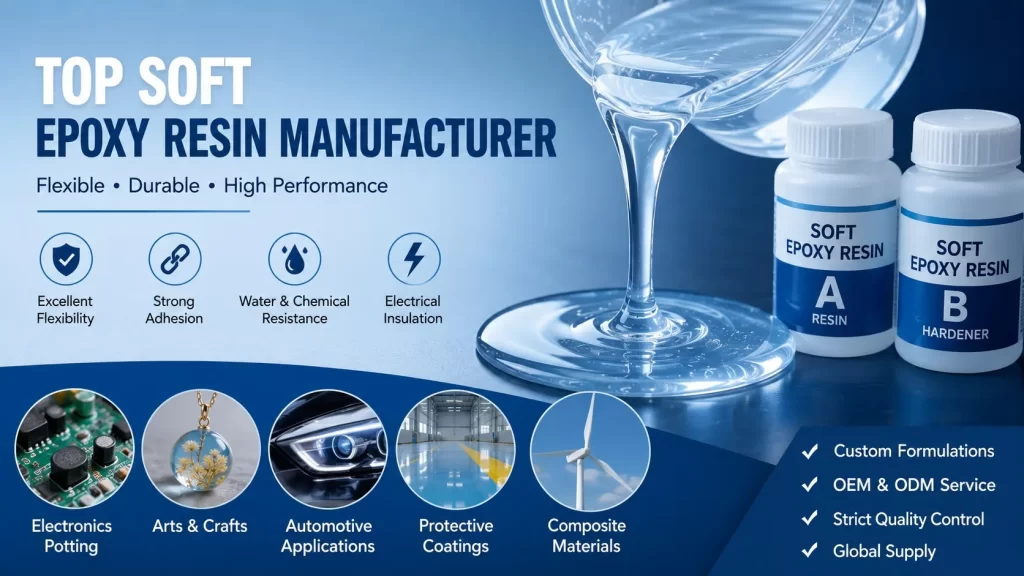
When looking for a high-quality epoxy resin manufacturer, knowing the characteristics of the material, production capabilities and the qualifications of the supplier will help you find a good long-term partner.
The following guide outlines all the steps to consider before choosing a soft epoxy resin manufacturer.
What Is Soft Epoxy Resin?
Soft epoxy resin is a specially formulated epoxy resin, which remains soft after curing. Unlike the conventional epoxy, soft epoxy is extremely elastic without reducing the bond strength.
This is done by changing the resin formulation with the use of flexible curing agents, reactive diluents, or elastomeric additives.
Common features include:
- High flexibility
- Strong adhesion
- Excellent transparency
- Good chemical resistance
- Water resistance
- Electrical insulation
- UV resistance (depending on formulation)
- Low shrinkage
- Long service life
The following properties make soft epoxy material appropriate for applications involving vibration, bending or thermal expansion.
Why Industries Prefer Soft Epoxy Resin
For modern manufacturing, materials with ability of resisting dynamic environment are required.
There are a number of significant benefits to soft epoxy resin.
Excellent Flexibility
Cured resin will absorb impact without cracking, and is suitable for products subjected to movement or stress.
Superior Adhesion
It bonds well to numerous substrates including:
- Metal
- Glass
- Wood
- Plastic
- Ceramics
- Concrete
- Carbon fiber
Electrical Insulation
Many electronic manufacturers use soft epoxy resin for encapsulation because it provides excellent dielectric properties.
Chemical Resistance
Soft epoxy resists:
- Oils
- Water
- Mild acids
- Alkalis
- Cleaning chemicals
This extends product lifespan.
Long-Term Durability
Premium formulations resist:
- Yellowing
- Moisture
- Temperature changes
- Mechanical fatigue
Major Applications of Soft Epoxy Resin
Soft epoxy resin serves numerous industries.
Electronics Potting
Manufacturers use soft epoxy for:
- LED modules
- Sensors
- PCB encapsulation
- Transformers
- Power supplies
- Automotive electronics
Its flexibility protects components from vibration and thermal cycling.
Art and Crafts
Artists appreciate soft epoxy because it offers:
- Crystal-clear finish
- Bubble-free appearance
- Smooth surface
- Flexible texture
Applications include:
- Jewelry
- Decorative molds
- DIY crafts
- Keychains
- Souvenirs
Industrial Bonding
Flexible epoxy adhesives are used in:
- Automotive assembly
- Composite manufacturing
- Aerospace components
- Marine equipment
The material accommodates expansion and contraction without losing bond strength.
Protective Coatings
Soft epoxy coatings provide:
- Waterproof protection
- Abrasion resistance
- Chemical protection
- Decorative appearance
These coatings are widely used for industrial equipment and flooring.
Composite Materials
Composite manufacturers use soft epoxy in:
- Carbon fiber parts
- Fiberglass products
- Sports equipment
- Wind turbine components
The flexibility improves impact resistance.
Characteristics of a Top Soft Epoxy Resin Manufacturer
Not all suppliers provide consistent quality.
A professional manufacturer should offer much more than resin production.
Advanced Manufacturing Equipment
Reliable manufacturers invest in:
- Automated production lines
- Precision mixing systems
- Vacuum degassing equipment
- High-quality reactors
- Automated filling systems
These technologies improve product consistency.
Strict Quality Control
Quality assurance should include:
- Raw material inspection
- Batch testing
- Viscosity measurement
- Hardness testing
- Transparency inspection
- Cure performance testing
- Shelf-life evaluation
International certifications such as ISO 9001 demonstrate standardized quality management.
Research and Development
Leading manufacturers continuously improve formulations.
An experienced R&D team develops products featuring:
- Faster curing
- Better UV stability
- Lower viscosity
- Higher transparency
- Improved flexibility
- Enhanced chemical resistance
Innovation helps customers stay competitive.
Custom Formulation Services
Different industries require unique resin properties.
Top manufacturers offer customized solutions based on:
- Hardness
- Elasticity
- Working time
- Curing speed
- Viscosity
- Color
- Temperature resistance
OEM and ODM services are valuable for private-label brands and industrial buyers.
How to Evaluate a Soft Epoxy Resin Supplier
Before placing large orders, buyers should evaluate several important factors.
Manufacturing Experience
Years of experience often indicate stable production processes.
Experienced manufacturers understand different industry requirements and provide practical technical support.
Production Capacity
Large production capacity ensures:
- Stable supply
- Short lead times
- Bulk order capability
- Consistent product quality
This becomes especially important for growing businesses.
Technical Support
Professional suppliers assist customers with:
- Product selection
- Mixing ratios
- Application guidance
- Process optimization
- Problem solving
Technical expertise reduces production risks.
Global Export Experience
International buyers benefit from manufacturers familiar with:
- Export regulations
- International certifications
- Safe packaging
- Customs documentation
- Worldwide logistics
This simplifies procurement.
Industries That Need Soft Epoxy Resin
Demand continues to increase in many sectors.
Major industries include:
- Electronics manufacturing
- Automotive
- Renewable energy
- Construction
- Marine
- Aerospace
- Medical devices
- Consumer products
- Art supplies
- Industrial equipment
Growing automation and smart electronics continue driving demand worldwide.
Trends in the Soft Epoxy Resin Market
Several trends are shaping the future of the industry.
Eco-Friendly Formulations
Manufacturers are developing:
- Low-VOC systems
- Solvent-free products
- Environmentally friendly curing agents
Sustainability is becoming a competitive advantage.
Faster Production Cycles
Customers increasingly request:
- Rapid curing
- Lower processing temperatures
- Shorter production time
These improvements reduce manufacturing costs.
Higher Transparency
Clear epoxy remains popular for:
- LED encapsulation
- Artistic applications
- Decorative products
- Optical components
Manufacturers continue improving clarity and UV resistance.
Smart Manufacturing
Leading factories are adopting:
- Automated quality inspection
- Digital production management
- AI-assisted formulation optimization
- Real-time process monitoring
These technologies improve consistency and efficiency.
Why Work Directly with a Manufacturer?
Purchasing directly from a manufacturer offers significant advantages.
Benefits include:
- Competitive factory pricing
- Consistent product quality
- Custom formulations
- Technical engineering support
- Faster communication
- Reliable inventory
- Flexible OEM/ODM services
- Long-term partnership opportunities
Direct sourcing also eliminates unnecessary intermediary costs.
Questions to Ask Before Choosing a Manufacturer
Before signing a supply agreement, ask:
- How many years have you produced epoxy resin?
- Can you customize formulations?
- What certifications do you hold?
- What is your production capacity?
- Do you provide technical support?
- Can you supply samples?
- What testing procedures do you use?
- What is your lead time?
- Do you export globally?
- What packaging options are available?
These questions help identify reliable suppliers.
Conclusion
When seeking the best soft epoxy resin manufacturer, it's not just about the cost. Consistency of quality, technical skills, production capacity, and customization are all key to a long-term successful business.
A reliable manufacturer provides consistent formulations, quality control, technical support, and production capacity to cater to the changing demands of a wide range of industries such as electronics, automobiles, construction, and creative uses.
With the increasing global needs for flexible, high-performance materials, working with a proven supplier of soft epoxy resin can result in more reliable products, lower manufacturing costs, and a more competitive product offering.