





Gypsum powder is a mineral-based product that can be utilized in many different applications including construction, agriculture, manufacturing, and other uses. It is manufactured from natural gypsum rock and may be processed to exhibit various properties based on purity, particle size, setting properties and performance.
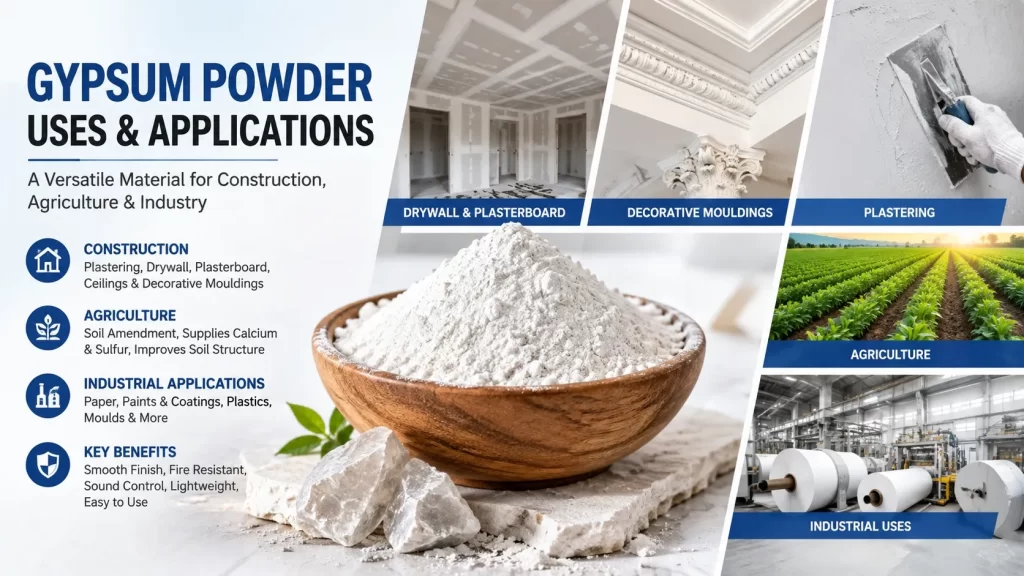
Gypsum powder is of particular significance in modern construction where it can be used to produce gypsum plaster, drywall, plasterboards, decorative products and other construction products. It is a light material, smooth finish and easy to apply making it a good alternative material to plaster in appropriate projects.
What Is Gypsum Powder?
Gypsum is a naturally occurring mineral that consists mainly of calcium sulphate dihydrate. The gypsum rock can be broken down and heated using carefully controlled conditions, whereby some of the chemically bound water is volatilised, leaving gypsum powder which can be caused to re-harden by water.
Gypsum powder has different properties depending on its application and its grade. The specifications of the construction-grade gypsum, agricultural gypsum, and industrial gypsum may differ; the buyer must choose the product based on the different applications.
1. Gypsum Powder for Wall and Ceiling Plastering
An application of gypsum powder is in wall and ceiling plastering. Gypsum plaster is created by mixing water with the plaster. Gypsum plaster is then applied to appropriate interior surfaces to form a smooth and even surface.
Gypsum plaster can make some interior finishing jobs easier than those made using a traditional cement-sand plaster. It can be applied relatively quickly and in general, it will not have to undergo the water curing process similar to conventional cement plaster. These properties can be useful for the contractor to speed up the process and proceed to the next stage of tasks, for example painting.
In general, gypsum plaster is used for appropriate interior use, and cannot be used as a substitute for cement-based materials in all situations.
2. Drywall and Plasterboard Manufacturing
Gypsum powder is one of the basic materials used in the production of gypsum boards, dry wall and plasterboards. They are a common material for use in interior partition construction, ceilings, wall linings and other lightweight construction systems.
Gypsum boards have a number of practical benefits such as low-weight, easy installation and a smooth surface for finishing. Specialized gypsum boards can also deliver enhanced fire-, moisture- or acoustic performance, depending on the type of board used and system designed.
This is why gypsum-based board systems have become popular in residential, commercial, office and hospitality building and home construction, as well as in institutional building construction.
3. Decorative Mouldings and Interior Design
Another important application of gypsum powder is decorative design. Gypsum-based materials can be shaped into different profiles and moulds, making them suitable for architectural details such as:
- Ceiling cornices
- Decorative panels
- Wall mouldings
- Ceiling medallions
- Columns and ornamental details
- Custom interior patterns
Because gypsum can be formed into detailed shapes, designers can use it to create both traditional and contemporary architectural features.
4. Fire-Resistant Building Applications
There is chemically bound water in the gypsum, and that is a part of what makes gypsum fire-resistant. Exposed to high temperatures, this water vaporizes, delaying the increase in temperature of building assemblies made of gypsum.
Therefore, gypsum products are used extensively in fire rated wall, ceiling and partition systems. Of significant importance, however, is that actual fire performance is not that of the gypsum powder alone, but the whole tested construction system.
This is especially useful in buildings where passive fire protection is a design criterion, as it has a high value in these applications.
5. Acoustic and Sound-Control Applications
Gypsum products can also be used to help with acoustic properties. Gypsum boards are often used in partition and ceiling assemblies that are intended for sound reduction.
Several factors such as the wall construction, the thickness of the boards, the insulation, air gaps, joints, and the whole assembly will influence the final sound performance. Thus, gypsum can be regarded as a component of a functional acoustical system and not as a standalone acoustical material.
6. Gypsum Powder in Agriculture
The agricultural uses of gypsum are based on the fact that it provides calcium and sulfur, which are essential nutrients in growing plants. Agricultural gypsum may also be used as a soil amendment in special soil management circumstances.
An important application is to improve soil structure, especially for some sodic or poorly-structured soils. When applied properly, gypsum provides the soil with soluble calcium ions that may enter the soil exchange sites to displace sodium ions, and enhance soil physical properties.
It also can supply sulfur to crops. Gypsum is not all-purpose fertilizer nor a replacement for all soil amendments, however. Application rates and suitability should be based on soil testing and agronomic recommendations.
7. Industrial Applications of Gypsum
Beyond construction and agriculture, gypsum can be used as a functional mineral or raw material in different industrial processes.
Paper Manufacturing
Gypsum and other mineral fillers may be incorporated into certain paper-related formulations to influence properties such as opacity, surface characteristics, and printability. The exact application depends on the manufacturing process and product specification.
Paint and Coating Products
Mineral fillers can be used in paint and coating formulations to influence viscosity, texture, coverage, and surface properties. Gypsum may be selected for specific formulations where its physical characteristics provide a useful function.
Plastics and Polymers
In selected plastic and polymer formulations, mineral fillers can modify cost, density, dimensional characteristics, and surface appearance. Gypsum can serve as a filler in applications where its properties are compatible with the polymer system.
Other Manufacturing Processes
Gypsum-based materials can also be used in specialized industrial applications, including mould-making and other processes where controlled setting and shape retention are valuable.
Key Benefits of Gypsum Powder
Why is gypsum powder so widely used?
Smooth Surface Finish
Gypsum plaster can produce a smooth, uniform surface, reducing the amount of additional preparation needed before decorative finishing.
Convenient Application
For suitable interior applications, gypsum plaster can be relatively easy to mix, apply, level, and finish.
Reduced Construction Time
Its setting characteristics and lack of conventional water curing can help shorten certain interior finishing schedules.
Lightweight Building Solutions
Gypsum-based boards and decorative products can provide lighter alternatives to some traditional construction materials, which is useful for modern interior construction.
Design Flexibility
Gypsum can be used to create simple surfaces as well as detailed decorative shapes, giving architects and interior designers considerable flexibility.
Versatile Industrial Material
Beyond construction, gypsum can function as a mineral resource for agricultural and industrial applications.
Gypsum Powder vs. Cement Plaster
Gypsum plaster and cement plaster both have important roles in construction, but they are not interchangeable in every situation.
Gypsum plaster is often preferred for suitable interior walls and ceilings because it offers convenient application, smooth finishing, and no conventional water-curing requirement. Cement-based plaster, on the other hand, is widely used in areas where greater moisture resistance and exterior durability are required.
The correct choice depends on the building location, environmental conditions, substrate, required finish, project schedule, and applicable construction standards.
Rather than asking which material is universally “better,” contractors should select the plaster system that matches the specific project requirements.
How to Choose the Right Gypsum Powder
Choosing the right gypsum powder requires more than comparing prices. Consider the following factors:
1. Purity and consistency:
A consistent raw material can contribute to predictable processing and finishing performance.
2. Intended application:
Construction plaster, gypsum board production, agriculture, and industrial applications require different grades and specifications.
3. Setting characteristics:
Check the manufacturer's recommended setting and working times to ensure compatibility with your production or construction process.
4. Particle size:
Particle-size distribution can influence mixing, dissolution, workability, and final performance.
5. Technical documentation:
Look for product specifications, test data, safety information, and quality-control documentation.
6. Supplier reliability:
A dependable supplier should provide consistent quality, technical support, packaging options, and reliable delivery.
Frequently Asked Questions About Gypsum Powder
What is gypsum powder mainly used for?
The most common applications include gypsum plaster, drywall and plasterboard manufacturing, decorative mouldings, construction systems, agriculture, and selected industrial processes.
Is gypsum powder suitable for plastering?
Yes. Suitable construction-grade gypsum powder can be formulated into gypsum plaster for interior walls and ceilings. The product should always be selected according to the manufacturer's technical specifications.
Does gypsum plaster require water curing?
Gypsum plaster generally does not require the conventional water-curing process used for cement plaster, which can simplify interior finishing schedules.
Can gypsum powder be used in agriculture?
Yes. Agricultural gypsum can provide calcium and sulfur and may improve soil properties in specific conditions. Soil testing is recommended before large-scale application.
Is gypsum environmentally friendly?
Gypsum is a naturally occurring mineral, but its overall environmental impact depends on extraction, processing, transportation, energy consumption, and the specific product formulation. It should therefore be evaluated across its complete life cycle.
Conclusion
Gypsum powder comes with a lot of uses other than just wall plastering. It is used in a variety of applications because of the combination of its workability and functional mineral properties: from gypsum plaster, drywall, ceilings and decorative mouldings to agriculture, paper, coatings, plastics and other industrial applications.
The most critical factors for construction projects are product grade, application environment, setting characteristics, technical specifications and supplier consistency. Selecting the appropriate gypsum powder can positively enhance workability, surface properties, construction efficiency and project performance.
As a builder, contractor, manufacturer, distributor or agricultural professional, it is important to know the various gypsum powder applications to choose the proper grade for your application.