





The use of composite materials has revolutionised the field of modern manufacturing due to their superior strength, light weight and durability. Whether for the aerospace industry, automotive engineering, marine engineering or the renewable energies sector, high-performance composites require one key ingredient: epoxy resin.
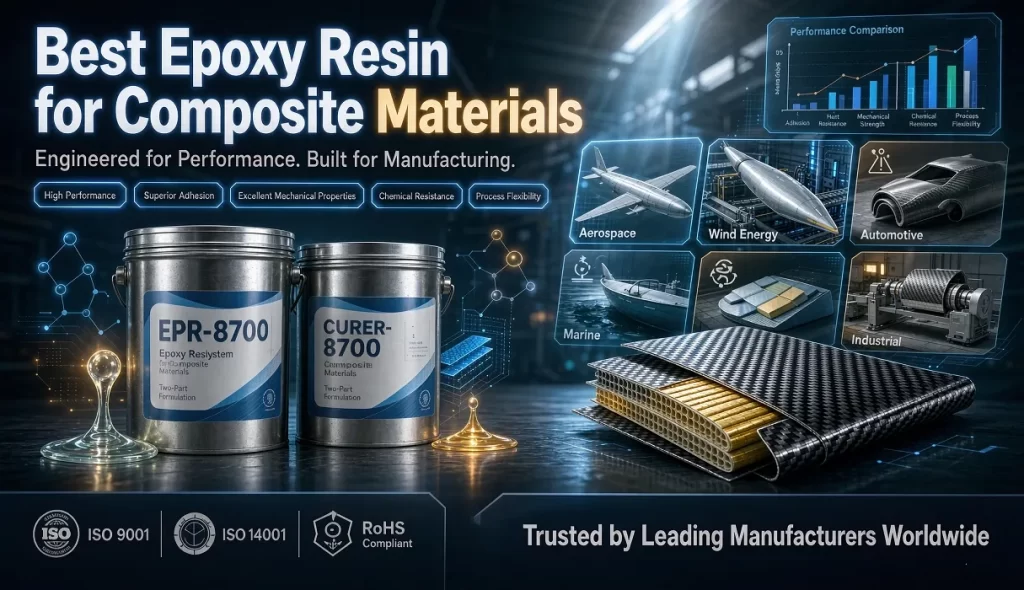
Selecting the top epoxy resin for composite materials manufacturer goes beyond just the cost factor. The quality of the resin directly influences the reliability, efficiency in production, chemical resistance, and mechanical strength. Whether you are manufacturing carbon fiber parts, fiberglass laminates or advanced industrial composites, you can be assured that your product will perform reliably and that your supply will not be interrupted by a manufacturer who you can trust.
This guide elucidates the details every buyer has to know about Epoxy Resin for composite manufacturing.
What Is Epoxy Resin for Composite Materials?
Epoxy resin is a type of thermosetting polymer that is commonly used as matrix material in fiber-reinforced composites. Epoxy systems offer better adhesion, low shrinkage and excellent mechanical properties as compared to polyester or vinyl ester resins.
When mixed with an appropriate hardener, epoxy resin will harden to form a very hard and strong compound that will bond to reinforcement fibers like:
- Carbon fiber
- Fiberglass
- Aramid (Kevlar)
- Basalt fiber
- Natural fibers
The end product is a lightweight composite material that has outstanding structural strength.
Why Epoxy Resin Is Preferred for Composite Manufacturing
Epoxy is used by manufacturers in a variety of industries due to a combination of mechanical performance and processing flexibility.
Superior Mechanical Strength
Epoxy resin creates strong molecular cross-linking during curing, resulting in:
- High tensile strength
- Excellent compressive strength
- Superior flexural performance
- Outstanding fatigue resistance
These characteristics make epoxy ideal for load-bearing structures.
Excellent Adhesion
Epoxy bonds effectively to numerous substrates including:
- Metals
- Wood
- Carbon fiber
- Glass fiber
- Concrete
- Engineering plastics
Strong adhesion improves laminate quality while minimizing delamination.
Low Shrinkage
Compared with polyester resin, epoxy shrinks very little during curing.
Benefits include:
- Better dimensional accuracy
- Reduced internal stress
- Improved surface finish
- Higher precision components
Outstanding Chemical Resistance
Industrial composite parts often encounter:
- Fuels
- Oils
- Solvents
- Acids
- Alkalis
- Moisture
High-quality epoxy systems resist chemical degradation, extending product lifespan.
High Temperature Performance
Many advanced epoxy formulations maintain excellent structural integrity under elevated temperatures.
Applications include:
- Automotive engine components
- Aerospace structures
- Wind turbine blades
- Industrial machinery
Industries Using Composite Epoxy Resin
The versatility of epoxy resin makes it suitable for numerous industrial sectors.
Aerospace
Aircraft manufacturers require lightweight materials capable of withstanding extreme mechanical stress.
Applications include:
- Interior panels
- Structural components
- Aircraft fairings
- Carbon fiber assemblies
Automotive
Modern vehicles increasingly rely on composite materials for weight reduction.
Typical applications include:
- Body panels
- Battery enclosures
- Structural reinforcement
- Racing components
Marine
Marine-grade epoxy resists water absorption while providing long-term durability.
Common products include:
- Boat hulls
- Deck structures
- Yacht components
- Composite repairs
Wind Energy
Wind turbine blades require:
- High stiffness
- Excellent fatigue resistance
- Long service life
Epoxy resin remains the preferred matrix material for large composite blades.
Sporting Goods
Manufacturers use epoxy composites for:
- Bicycles
- Tennis rackets
- Golf clubs
- Helmets
- Skis
- Surfboards
The result is lighter equipment with improved strength.
Construction
Composite materials are increasingly used in infrastructure projects.
Examples include:
- Bridge reinforcement
- Structural panels
- FRP rebar
- Industrial flooring
Key Features of the Best Epoxy Resin Manufacturer
Not all epoxy suppliers deliver the same level of quality. Consider these factors when evaluating manufacturers.
Consistent Product Quality
Reliable manufacturers maintain strict quality control throughout production.
Look for:
- Stable viscosity
- Consistent curing behavior
- Batch-to-batch uniformity
- Low impurity levels
Consistency reduces production defects and waste.
Extensive Product Portfolio
A leading supplier should offer multiple resin systems, including:
- Laminating epoxy resin
- Infusion resin
- Hand lay-up resin
- Pultrusion resin
- Filament winding resin
- High-temperature epoxy
- Low-viscosity systems
- Fast-curing epoxy
A broad portfolio allows manufacturers to optimize processes for different applications.
Custom Formulation Services
Every production process has unique requirements.
Professional manufacturers often provide OEM and customized solutions based on:
- Viscosity
- Pot life
- Cure speed
- Glass transition temperature (Tg)
- Mechanical properties
- Color
- UV resistance
Customization helps improve production efficiency while meeting product specifications.
International Certifications
Quality certifications demonstrate compliance with international standards.
Important certifications include:
- ISO 9001
- ISO 14001
- REACH compliance
- RoHS compliance
- SGS testing
These certifications increase buyer confidence.
Technical Support
Experienced suppliers assist customers with:
- Material selection
- Processing recommendations
- Curing schedules
- Product optimization
- Troubleshooting
Strong technical support helps reduce development time.
How to Select the Right Composite Epoxy Resin
Different manufacturing methods require different resin characteristics.
Vacuum Infusion
Recommended features:
- Low viscosity
- Long working time
- Excellent fiber wetting
- Low exotherm
Hand Lay-Up
Ideal properties include:
- Easy mixing
- Medium viscosity
- Good air release
- Strong adhesion
Resin Transfer Molding (RTM)
RTM systems require:
- Controlled viscosity
- Fast injection
- Stable curing
- High mechanical performance
Filament Winding
Suitable epoxy should provide:
- Excellent fiber impregnation
- Controlled gel time
- High bond strength
- Heat resistance
Advantages of Working Directly with a Manufacturer
Purchasing directly from an epoxy resin manufacturer offers significant benefits.
Competitive Pricing
Factory-direct purchasing eliminates intermediary costs while improving overall value.
Stable Supply Chain
Large manufacturers ensure consistent production capacity and reliable delivery schedules.
OEM & Private Label
Many manufacturers provide:
- Customized packaging
- Brand labeling
- Product formulation
- Technical documentation
This is particularly valuable for distributors and industrial brands.
Quality Assurance
Direct manufacturers maintain greater control over raw materials, production, and testing.
Future Trends in Composite Epoxy Resin
The composite industry continues to evolve with new technologies.
Key developments include:
- Bio-based epoxy resins
- Low-VOC formulations
- Faster curing systems
- Recyclable composite materials
- High-temperature aerospace grades
- Improved fire-retardant performance
- Enhanced UV stability
- Smart resin systems for advanced manufacturing
Innovators in manufacturing are more likely to be able to respond to the future needs of the market.
Why Global Buyers Prefer Experienced Manufacturers
Industrial buyers are more interested in long-term manufacturing partners than just a one-time supplier.
An experienced epoxy resin manufacturer provides:
- Advanced R&D capabilities
- Stable global supply
- Competitive pricing
- Flexible OEM services
- Fast technical response
- Consistent product quality
- International logistics support
- Sustainable manufacturing practices
These benefits contribute to minimizing procurement risks and also enhance production efficiency.
Conclusion
When searching for the best epoxy resin for composite materials manufacturer, the price is just one of the many factors to consider. Ensuring long-term manufacturing success requires product consistency, technical expertise, customization, international certifications, and a reliable supply.
Whatever product you are creating – aerospace components, automotive parts, wind turbine blades, marine structures, industrial composites – having a trusted epoxy resin manufacturer as your partner guarantees quality performance and production capabilities.
With the increasing demand for lightweight, high-strength composite products worldwide, the right manufacturing partner today can mean years of competitive edge.