




When you have an existing tile floor that seems to be outdated, damaged or hard to maintain, you may ask yourself: Can you install epoxy over tile?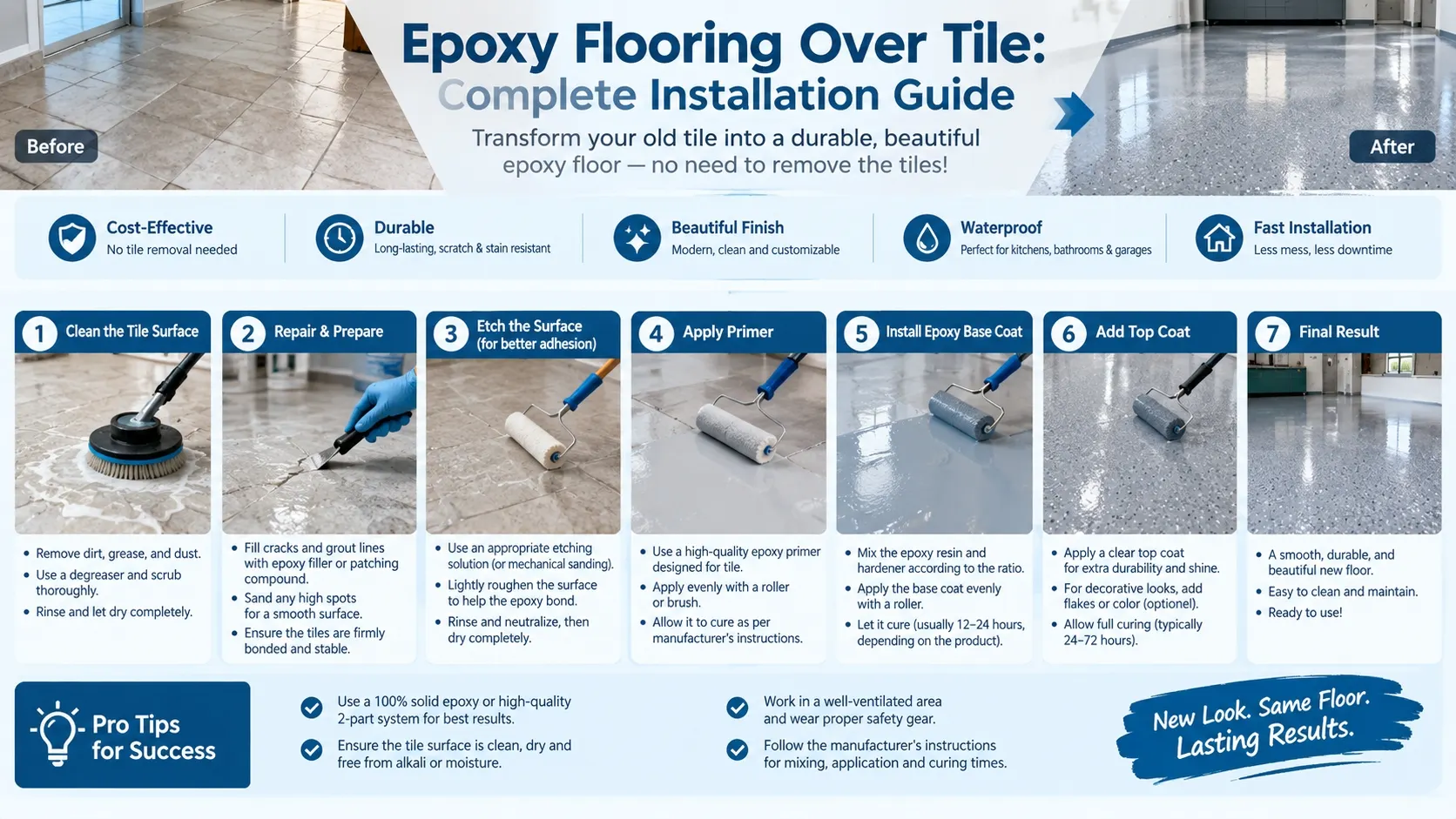
Sí, epoxy flooring can be installed on existing tiles provided the tile surface is stable, clean, tile surface is prepared and suitable for coating. Directly rolling epoxy on a shiny tile will not likely give you a lasting finish.
Epoxy can be applied over tile for many residential, retail, commercial and light industrial projects, and can provide a seamless floor surface that is easy to clean and durable. But preparation of the surface and condition of the substrate have much more influence on the success of the project than the epoxy itself.
Can Epoxy Flooring Go Over Existing Tiles?
Sí. When the tile surface is securely prepared and bonded, epoxy flooring can be installed over existing tile surfaces.
The most challenging factor is adhesion. Some ceramic and porcelain tiles have very smooth, glazed or sealed surfaces, which have little natural texture for good adhesion for epoxy. Another problem is that grout is porous and can hold grease, dirt, oil or other substances in it.
The following three factors should be considered before contractors install the device:
- Will the epoxy bond to the tile?
- Are the existing tiles firmly attached to the substrate?
- Can the tiled surface be made sufficiently flat?
If the answer to any of these questions is no, removing the tiles and preparing the underlying concrete may be the better solution.
Why Surface Preparation Matters
Surface preparation is arguably the most important part of installing epoxy flooring over tile.
Epoxy performs best when it is applied to a clean, sound, mechanically prepared surface. A glossy tile surface can prevent proper adhesion, causing the coating to peel, crack, or delaminate later.
1. Remove the Glossy Surface
Glazed tiles are often smooth and non-porous. Before applying epoxy, the surface normally needs mechanical preparation, such as diamond grinding, to remove the glossy finish and create an appropriate profile.
Some highly dense or vitrified tiles may require a compatible specialty primer in addition to mechanical preparation.
Chemical etching may sometimes be considered, but mechanical preparation generally provides more predictable results for difficult tile surfaces.
2. Clean the Tiles and Grout
Cleaning is equally important.
Grout is porous and can absorb grease, oils, dirt, and cleaning chemicals. This is especially important in kitchens, workshops, Restaurantes, garages, and commercial areas where floors may have been exposed to heavy contamination.
Any grease, wax, sealers, dirt, or other bond-inhibiting contaminants should be removed before coating.
A clean surface helps the primer and epoxy establish a stronger mechanical and chemical bond.
Check for Loose or Damaged Tiles
Even if epoxy can bond successfully to the tile surface, the entire flooring system can still fail if the tiles underneath are loose.
Tiles can become partially detached from the concrete over time. These areas may sound hollow when tapped and are sometimes described as "drummy" tiles.
If a tile moves, grietas, pops, or breaks during preparation, it should not simply be covered with epoxy.
Why?
Because epoxy cannot fix a weak substrate. If the tile eventually separates from the concrete, the epoxy coating installed over it may fail as well.
For this reason, a professional inspection should identify loose, cracked, hollow, or unstable tiles before coating begins. If there are widespread substrate problems, removing the tiles may be the safer long-term option.
How to Hide Grout Lines Under Epoxy
One of the biggest visual challenges when installing epoxy over tile is grout-line ghosting.
Even when the final coating feels completely smooth, the original tile pattern can sometimes become visible through the new floor.
This can happen because grout joints are lower than the tile surface. If they are not properly filled and leveled, the epoxy system may reproduce the underlying pattern.
A suitable patching or leveling compound can be used to create a more uniform substrate before applying the epoxy system.
Sin embargo, choosing the right leveling material is important. Some highly porous leveling products can contribute to bubbles or differences in surface appearance, while incompatible materials may move differently from the tile substrate and allow grout patterns to reappear over time.
Step-by-Step: How to Apply Epoxy Over Tile
Although installation methods vary according to the epoxy system and tile type, the general process includes the following steps:
Step 1: Inspect the Existing Floor
Check for loose, cracked, damaged, hollow, or unstable tiles. Identify areas affected by moisture, Petróleo, grease, or other contamination.
Step 2: Remove Contamination
Thoroughly clean the floor and remove grease, oils, waxes, sealers, dirt, and other contaminants.
Step 3: Mechanically Prepare the Surface
Grind or otherwise mechanically abrade the tile surface to remove excessive gloss and create a suitable profile for the coating system.
Step 4: Repair Grout Lines and Defects
Fill deep grout joints, grietas, chips, holes, and other irregularities with a compatible repair or leveling material.
Step 5: Apply the Appropriate Primer
Depending on the tile type and epoxy system, a bonding or specialty primer may be required to improve adhesion.
Step 6: Apply the Epoxy Flooring System
Apply the epoxy according to the manufacturer's recommended mixing ratio, coverage rate, thickness, working time, and curing conditions.
Step 7: Apply a Topcoat if Required
For areas exposed to heavy traffic, Químicos, abrasion, UV exposure, or frequent cleaning, a compatible protective topcoat may be recommended.
Advantages of Epoxy Flooring Over Tile
Installing epoxy over existing tile can offer several advantages:
Less demolition: Keeping a suitable tile substrate can reduce the need for extensive tile removal.
Less construction waste: Avoiding demolition can reduce the amount of old tile and adhesive sent to disposal.
Seamless appearance: Epoxy can create a continuous surface without conventional tile joints.
Easy maintenance: A properly installed epoxy floor has a smooth, relatively easy-to-clean surface.
Modern appearance: Epoxy flooring is available in many colors, finishes, decorative flakes, metallic effects, and other designs.
Potentially shorter renovation time: When the existing substrate is suitable, avoiding full tile removal may simplify the renovation process.
When Should You Remove the Tiles?
Epoxy over tile is not the right solution for every floor.
Tile removal may be preferable when:
- Numerous tiles are loose or hollow.
- The existing floor has extensive cracking.
- The tiles are severely damaged.
- The substrate has significant moisture problems.
- Heavy contamination cannot be adequately removed.
- The floor is excessively uneven.
- The existing tile system is structurally unreliable.
Removing tiles does introduce additional labor. Tile adhesive and leveling materials underneath can be difficult to remove, and demolition may damage the concrete. The exposed slab may then require patching or leveling before epoxy installation.
What About Floor Height?
Floor height is another important consideration.
Existing tile floors can add significant thickness to a floor assembly because of the combination of tile, adhesive, and leveling materials. After tile removal, installing a relatively thin epoxy coating may leave gaps around doors, skirting boards, transitions, or other fixtures.
Por lo tanto, tile removal should always be evaluated together with the required finished floor height—not simply the cost of demolition.
Preguntas frecuentes
Is epoxy flooring over tile a good idea?
It can be a good solution when the tiles are stable, clean, dry, and properly prepared. The condition of the existing floor is more important than simply the type of tile.
Can epoxy stick to ceramic tile?
Sí, but ceramic tile often needs mechanical abrasion to remove the glossy surface and improve adhesion. A compatible primer may also be required.
Can you epoxy over porcelain tile?
It may be possible, but porcelain can be particularly dense and non-porous. Proper mechanical preparation and a suitable primer may be necessary.
Will grout lines show through epoxy?
They can. If grout joints are not properly filled and leveled, the original tile pattern may become visible through the epoxy, a problem often referred to as ghosting.
Is it cheaper to epoxy over tile or remove tile first?
The answer depends on the condition of the existing floor. Keeping sound tiles can reduce demolition work, but extensive preparation, leveling, or repair can reduce the potential savings.
Final Thoughts
Sí, it is possible to have epoxy flooring installed over tile...but it will depend on the preparation.
The first step to a successful project is a complete inspection. The tiles must be securely joined, any contaminants must be taken away, any shiny surfaces must be properly mechanically prepared and any irregularities, such as irregular grout lines must be dealt with.
If the present tiles are unstable or in bad condition, it may be better to remove them and prepare the concrete.
So, don't consider epoxy flooring over tile as just another quick and easy option. If the existing floor is appropriate and the surface is set up properly, sin embargo, it can be a way to create a seamless, durable and contemporary surface in an old tiled floor.